Choosing acoustic guitar strings as a beginner comes down to one key decision: bronze (phosphor bronze or 80/20) for a bright, resonant tone on steel-string acoustics, or nylon for a warmer, gentler feel on classical guitars. Bronze strings suit most beginners on standard acoustic guitars; nylon strings are ideal for fingerstyle and classical players. In 2026, phosphor bronze sets like D'Addario EJ16 remain the top beginner recommendation for steel-string acoustics. Top beginner picks: Ernie Ball Regular Slinky (.010–.046, ~$6) for electric, D'Addario EJ16 Phosphor Bronze (.012–.053, ~$8) for acoustic, and Elixir Nanoweb (.011–.052, ~$15) for acoustic players who want longer string life. Change strings every 1–3 months.
String choice is one of the most overlooked factors in beginner guitar progress. The wrong strings make your guitar harder to play, less comfortable on your fingers, and worse-sounding — all of which quietly kill motivation. The right <a href="/knowledge-hub/2026-06-22-best-guitar-strings-for-beginners">strings</a> make the instrument feel responsive, your fingers hurt less, and playing more enjoyable. Here's exactly what to look for and what to buy.
String Gauge Guide: What the Numbers Mean
Guitar string "gauge" refers to the thickness of the strings, measured in thousandths of an inch. A set labeled .010–.046 has a first string (high E) that is .010 inches thick and a sixth string (low E) that is .046 inches thick.
- Easier to press down and bend
- Less finger soreness during the learning phase
- Slightly brighter <a href="/knowledge-hub/guitar-string-gauge-tone-relationship">tone</a>
- Can break more easily with aggressive playing
- Require more finger strength and callus development
- Fuller, warmer, louder tone — especially on acoustic
- Better tuning stability when playing hard
- Not ideal until you've built up hand strength
For electric guitar beginners: Start with .009–.042 (super light) or .010–.046 (light). Most intermediate and advanced players settle on .010s as a lifetime choice.
For acoustic guitar beginners: Start with .011–.052 (light) or .012–.053 (light-medium). Acoustic strings need to be slightly heavier to produce enough volume and tone from an acoustic body, but anything above .013 is genuinely punishing for new fingers.
Never put electric strings on an acoustic guitar or vice versa — they're wound differently, tuned to different tensions, and won't sound right or sit properly on the wrong instrument.
Best Electric Guitar Strings for Beginners
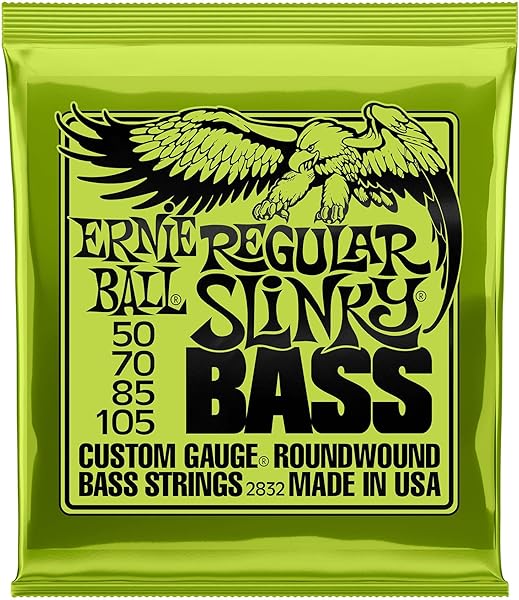
1. Ernie Ball Regular Slinky (.010–.046) — Best Overall for Electric Price: ~$6 per set
The Regular Slinky is the world's best-selling electric guitar string and the most widely recommended starting point for beginners. The .010 gauge threads the needle between easy playability and a full, warm tone. Ernie Ball strings are made from tin-plated hex-core wire wrapped with nickel-plated steel, producing the bright, punchy tone associated with rock and pop guitar. They're available at virtually every music store on earth, which means replacements are always easy to find.
Beginners who find .010s slightly stiff can drop to the Super Slinky (.009–.042) — these are a bit easier on the fingers, though they break more readily and require minor truss rod adjustments on some guitars.
2. D'Addario EXL110 (.010–.046) — Best for Consistency Price: ~$7 per set
D'Addario's XL series is the other dominant electric string brand. The EXL110 is a .010 set with a slightly rounder tone than Ernie Ball — more balanced mids compared to Ernie Ball's brighter character. D'Addario strings are manufactured to extremely tight tolerances, so every set plays and sounds virtually identical to the last. If you like consistency, D'Addario is your brand.
3. Fender Original Bullets (.009–.042) — Best Budget Super Light Price: ~$6 per set
Designed specifically for Fender Stratocasters and Telecasters (which have a string-through-body design), the Original Bullets feature a distinctive bullet-shaped end on the low strings. They're easy to play, affordable, and work on any electric guitar despite the Fender branding.
Best Acoustic Guitar Strings for Beginners
1. D'Addario EJ16 Phosphor Bronze (.012–.053) — Best Overall for Acoustic Price: ~$8 per set
The EJ16 is the most consistently recommended acoustic string for beginners and intermediate players. Phosphor bronze winding gives them a warm, full tone with clear highs — well-balanced across all frequencies without harsh brightness. The .012 gauge is the sweet spot for acoustic guitars: light enough that new fingers can manage them, heavy enough to produce the full acoustic sound most players expect. They last four to six weeks with regular playing before going dull.
2. Ernie Ball Earthwood Medium Light (.012–.054) — Best for Brightness Price: ~$7 per set
Ernie Ball's acoustic offering uses 80/20 bronze (80% copper, 20% zinc) rather than phosphor bronze, which produces a brighter, more cutting tone. Great for players who want their acoustic to stand out in a mix or who prefer a more articulate, present sound. The brightness fades faster than phosphor bronze, but new Earthwood strings have an immediacy that many players love.
3. Elixir Nanoweb Phosphor Bronze (.011–.052) — Best for Longevity Price: ~$15 per set
Elixir's Nanoweb coating encases the string in a thin polymer layer that dramatically extends string life — coated Elixir strings can last three to five times longer than uncoated strings before going dead. For beginners who don't change strings frequently, this can be a better value despite the higher upfront cost. The .011 gauge is also slightly lighter than most acoustic sets, making them genuinely comfortable for new players. The coating gives Elixir strings a slightly different feel under the fingers — some players love it, some don't. If possible, try one set before buying in bulk.
When to Change Guitar Strings
Knowing when strings are dead is a real skill. Old strings sound dull, won't intonate properly (notes go slightly sharp as you play up the neck), and feel grimy under your fingers.
- They've been on for more than 2–3 months with regular playing (or 1 month if you play daily)
- The tone sounds flat or dull compared to fresh strings
- There is visible grime or rust on the windings
- The strings won't stay in tune, especially at the higher frets
- You have a performance or recording session coming up — always restring 24 hours beforehand so new strings settle
For players just starting out, a useful rule of thumb: change strings the first time they break. That way you learn the process while the guitar clearly needs it.
Our [guide to changing acoustic guitar strings](/knowledge-hub/how-to-change-acoustic-guitar-strings) walks through the full process step-by-step.
Coated vs. Uncoated Strings
Uncoated strings (Ernie Ball, D'Addario standard lines) are bare metal. They produce the fullest, most natural tone from day one, but oxidize and accumulate sweat and oils from your fingers, causing them to go dead faster. Life expectancy: 4–8 weeks with regular playing.
Coated strings (Elixir Nanoweb, D'Addario XT, Ernie Ball Coated) have a polymer layer over the winding that significantly slows oxidation. They last 2–5x longer than uncoated strings, feel slightly slicker under the fingers, and can sound slightly less brilliant when brand new. Life expectancy: 3–6 months.
- You don't change strings often (most beginners)
- You have highly acidic sweat (your strings go dead in under 2 weeks)
- You want consistent tone over a long period
- You change strings monthly or more frequently
- You want maximum tonal brightness and response
- You prefer the feel of bare metal
For most beginners, starting with a standard uncoated set (D'Addario EJ16 or Ernie Ball Regular Slinky) makes sense — it's lower cost while you're still figuring out how you like your guitar to feel and sound. Once you have preferences, experimenting with coated sets is worthwhile.
FAQ
Do cheaper guitar strings sound bad? No — most mass-market strings from reputable brands (D'Addario, Ernie Ball, Fender, Martin) sound excellent for the price. String quality matters far less than string freshness: a $6 fresh set of Ernie Balls will sound much better than a $15 set of Elixirs that have been on for a year.
Can I put acoustic strings on an electric guitar? No. Acoustic strings are wound to higher tension and use different core materials designed for acoustic resonance. On an electric guitar, they won't sit correctly on the saddle, will strain the neck, and won't interact properly with the magnetic pickups (phosphor bronze is only weakly magnetic). Always use electric strings on an electric guitar.
How do I know what gauge strings came on my guitar from the factory? Most guitars ship with .009–.042 or .010–.046 on electric, and .012–.053 on acoustic. Check the manufacturer's website or call a music store — they can identify factory gauge from the model number. When in doubt, a set of .010s on electric or .012s on acoustic is a safe default.
For more on string selection and how gauge affects your tone, see our [acoustic guitar body types guide](/knowledge-hub/2026-06-02-types-of-acoustic-guitars-guide) and our [fingerpicking guitar for beginners](/knowledge-hub/2026-06-02-fingerpicking-guitar-for-beginners) guide for how string choice affects fingerstyle playing.
Ready to upgrade your setup? Visit [professionalgl.com/knowledge-hub](https://professionalgl.com/knowledge-hub) for more expert gear guides and recommendations from our Pro Concierge team. We'll help you find exactly the right strings, guitar, and accessories for your skill level and playing style.
See also: [Best Guitar Strings for Beginners: Choosing the Right Set](/knowledge-hub/2026-06-22-best-guitar-strings-for-beginners)
Browse Professional GL — Strings, Capos, Pedals & More. USA-Designed. Free Shipping on Orders $50+.
Trusted by 1,318+ professional musicians · 4.8 stars · 30-day money-back guarantee · Ships in 1–3 business days.
READY TO UPGRADE YOUR RIG?
Shop Guitar Strings, Capos & Pedals — Free Shipping $50+
USA-designed gear trusted by 1,318+ musicians. Free shipping on orders $50+. 30-day money-back guarantee.
Shop All Guitar Gear — Free Shipping $50+ →