The best guitar tuner for most beginners is a clip-on chromatic tuner — it costs $10–$20, clips to the <a href="/knowledge-hub/guitar-tuning-pegs-guide">headstock</a>, works for acoustic and electric guitar, and detects pitch accurately even in noisy environments. Pedal tuners ($50–$150) are the professional choice for electric players on pedalboards, offering signal muting between songs and easy stage visibility. Free tuner apps work well in quiet home practice but struggle with background noise. The most important feature to look for in any tuner: chromatic mode — which reads all 12 semitones, not just the 6 standard guitar strings.
Being even slightly out of tune is one of the most noticeable problems in any practice session, rehearsal, or performance. A $15 clip-on tuner solves this permanently. Understanding which tuner type fits your situation — and what features actually matter — helps you choose right the first time.
Types of Guitar Tuners: Clip-On, Pedal, and App
Three main tuner types exist, each best suited to different situations:
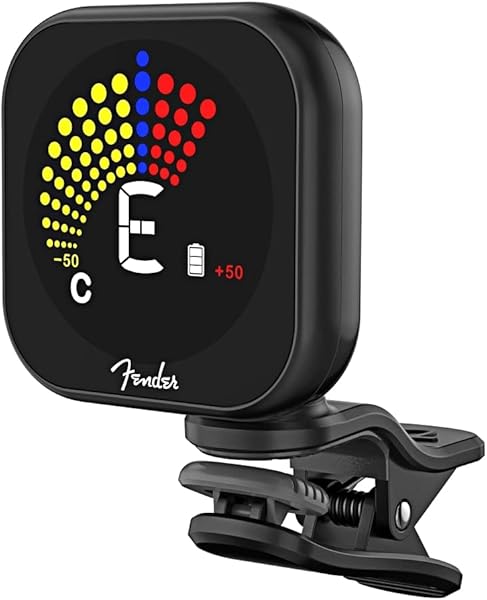
Clip-on tuners attach directly to the guitar's headstock and detect tuning through vibration (not sound waves), which means surrounding noise doesn't interfere. They work on acoustic and electric guitar equally well, require no cable, and run for 50–100 hours on a single coin cell battery. Price range: $10–$30.
Pedal tuners sit on your pedalboard and connect in-line with your guitar cable. When activated, they silence your amp while you tune — critical for live performance. The large LED display is visible from standing height under stage lighting, and most pedal tuners include a true bypass or buffer circuit. Price range: $40–$150+.
Tuner apps (GuitarTuna, Fender Tune, insTuner) use your phone's microphone to detect pitch. They're free, accurate in quiet rooms, and convenient for casual home practice. Their weakness: any background noise confuses the microphone, making them unreliable at rehearsals, venues, or even in homes with ambient TV noise.
Handheld desktop tuners (traditional box-style) are largely replaced by clip-ons but remain accurate. They require a cable (electric) or quiet space for the microphone (acoustic) and are less convenient than clip-ons for most scenarios.
Clip-On Tuners: Best for Most Beginners
For any guitarist who doesn't already use an electric pedalboard, a clip-on chromatic tuner is the right starting point. Three reasons:
1. Zero setup required. Clip it on, turn it on, play a string. No cable, no app to open, no interface to navigate. The display shows the note and whether you're sharp or flat. This simplicity matters when tuning between songs or at the start of each practice session.
2. Works for any instrument. The same clip-on tuner works on your acoustic, your electric, your bass, and your ukulele. One purchase covers every string instrument you own.
3. Reliable in noisy environments. Because clip-on tuners sense vibration through the headstock rather than sound through a microphone, surrounding noise doesn't interfere. You can tune at a loud rehearsal while the rest of the band plays.
What to look for in a clip-on tuner:
- Chromatic mode: Essential — reads all 12 semitones, not just E-A-D-G-B-E
- Color display: Green (in tune) vs. red (sharp/flat) is faster to read than a needle display, especially in low light
- 360-degree rotating screen: Position the display toward you regardless of which direction the tuner clips
- Flat tuning support: If you ever tune down (Eb standard, drop D, etc.), confirm the tuner supports alternate tunings
- Fast response time: The best tuners lock on to pitch within 0.5–1 second — slow tuners waste time while strings decay
Top clip-on tuner picks (2026):
- Snark ST-8 Super Tight ($15–$18): The most widely used clip-on in music stores. Fast, accurate, bright color display. Best all-around budget choice.
- D'Addario NS Micro Headstock Tuner ($15–$20): Extremely compact — tucks behind the headstock so it's nearly invisible on stage. Fast and accurate.
- TC Electronic PolyTune Clip ($30–$40): Includes polyphonic tuning — strum all 6 strings at once to see which are out of tune. Dramatically speeds up the tuning process for players who use it regularly.
Pedal Tuners: The Electric Guitar Standard
If you play electric guitar and use any effects pedals, a pedal tuner is the professional choice. It integrates into your signal chain and silences your amp while tuning — no buzzing, no accidental notes, no noise while you tune between songs at a gig.
Key pedal tuner features to evaluate:
- True bypass vs. buffered bypass: True bypass passes signal through with no electronic interference when the tuner is off. A buffered bypass adds a high-quality buffer that can actually improve tone in long cable runs. Both are valid — choose based on your rig.
- Display size and brightness: The TC Electronic PolyTune 3 and Boss TU-3 both have large LED displays clearly visible from standing height under stage lighting.
- Polyphonic mode: TC Electronic's polyphonic tuning (strum once, all 6 strings show simultaneously) tunes a guitar in 3 seconds versus 30 seconds for string-by-string tuning.
- Pitch reference: Most pedal tuners use A=440 Hz standard. Some allow adjustment for orchestral tuning or alternate reference pitches.
Top pedal tuner picks:
- Boss TU-3 ($60–$70): The industry-standard live tuner. Virtually indestructible, extremely accurate, bright display with multiple viewing modes, supports chromatic and guitar/bass modes. Hundreds of thousands of working musicians use this tuner.
- TC Electronic PolyTune 3 ($75–$90): Polyphonic tuning plus excellent build quality plus a selectable analog bypass buffer make this the modern standard for players who care about tone preservation.
- Korg Pitchblack ($40–$50): Accurate, affordable pedal tuner with a large display and true bypass. The best budget option for a first pedalboard.
Tuner Apps: Free and Good Enough for Home Practice
Free tuner apps have dramatically improved in accuracy. In quiet environments, GuitarTuna and Fender Tune are accurate to within a cent (1/100th of a semitone) and respond quickly enough for efficient tuning.
- Home practice in a quiet room
- Late-night sessions in a bedroom
- As a quick reference check when your hardware tuner isn't handy
- Rehearsals or jam sessions with other instruments
- Live venues or any space with ambient music
- Outdoor environments
- Any room with TV, conversation, or HVAC noise
The microphone picks up all surrounding sound, not just your guitar. Any nearby noise causes erratic, unreliable readings. For home use only: apps are excellent. For anything beyond home use: use a clip-on or pedal tuner.
Tuner Features That Actually Matter
Many beginners focus on brand names rather than specific features. Here's what actually affects day-to-day tuner performance:
Response speed. A slow tuner keeps you waiting while a string's sustain decays. Faster lock-on (0.5–1 second) is always better — especially for short-sustain acoustic notes on thin strings.
Accuracy (cents resolution). Professional standard is ±0.5 cents or better. Most chromatic tuners at $15+ meet this standard. "±1 cent" accuracy is still excellent for all practical playing.
Display readability. Color displays (green = in tune) are faster to interpret than needle-style displays, especially in dim light. Stage and rehearsal situations often involve low or changing light.
Chromatic vs. guitar-only mode. Guitar mode reads only E-A-D-G-B-E. Chromatic mode reads all 12 semitones — essential for drop D, open tunings, alternate tunings, capo use, or any deviation from standard. Always buy chromatic.
Battery life. Clip-on tuners using CR2032 coin cells typically last 50–100 hours of active use. Get in the habit of turning it off after each session — most clip-on tuners have auto-shutoff but it doesn't always engage.
FAQ
Do I need a separate tuner if my guitar amp has a built-in tuner? Built-in amp tuners work, but they require your amp to be on and don't silence your signal while tuning — meaning any string you play comes through the speaker. A clip-on tuner is more convenient for home practice and silent tuning. For gigging, a dedicated pedal tuner remains superior to any built-in amp tuner.
Is an expensive tuner more accurate than a $15 one? At $15 and above, clip-on tuners are accurate enough for all practical purposes — often more accurate than the <a href="/knowledge-hub/guitar-tuning-stability-tips">pitch stability of your strings</a> in changing temperatures. Spending more buys features (polyphonic tuning, better build quality, brighter display) rather than meaningfully better pitch accuracy. The $15 Snark and the $90 TC PolyTune get your guitar equally in-tune.
How often should I tune my guitar? Before every single practice session and performance. Strings go out of tune as temperature and humidity change, after bending strings, and simply over time. Many experienced players retune between every 2–3 songs during a set. Developing the habit of tuning every time you pick up the guitar is one of the best early habits you can build — and with a good clip-on tuner, it takes under 30 seconds.
Ready to level up your playing? Visit [professionalgl.com/knowledge-hub](https://professionalgl.com/knowledge-hub) for beginner gear guides and expert advice from our Pro Concierge.
Related Reading
- [How to Tune a Guitar: Step-by-Step Beginner Guide](/knowledge-hub/2026-06-20-how-to-tune-a-guitar)
- [How to Tune Guitar by Ear: A Complete Method](/knowledge-hub/2026-06-06-how-to-tune-guitar-by-ear)
---
Ready to upgrade your guitar gear? Browse our full selection of tuners, picks, and accessories at [PGL Music Store](/shop) and use our [Gear Finder Quiz](/gear-finder) to find the perfect setup for your style and budget. Free shipping available on qualifying orders.
*Related: [How to Change Guitar Strings](/knowledge-hub/2026-06-16-how-to-change-guitar-strings) | [Guitar String Stretching Guide](/knowledge-hub/guitar-string-stretching-guide)*
Browse Professional GL — Strings, Capos, Pedals & More. USA-Designed. Free Shipping on Orders $50+.
Trusted by 1,318+ professional musicians · 4.8 stars · 30-day money-back guarantee · Ships in 1–3 business days.
READY TO UPGRADE YOUR RIG?
Shop Guitar Strings, Capos & Pedals — Free Shipping $50+
USA-designed gear trusted by 1,318+ musicians. Free shipping on orders $50+. 30-day money-back guarantee.
Shop All Guitar Gear — Free Shipping $50+ →